Forming machines give sheet metal its final shape: they bend, fold, bead or profile a flat blank without removing material.
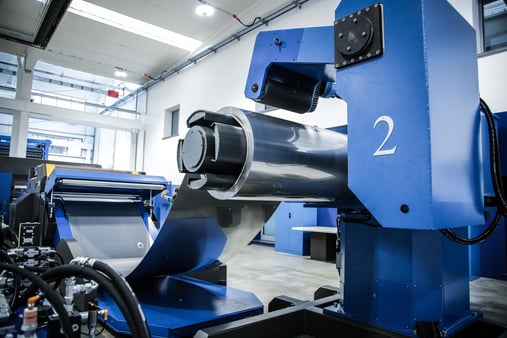
For a manufacturer, the decisive question is rarely which forming machine to buy in isolation, but where forming sits in the production flow. Produtech builds coil-fed lines in which cutting and forming follow one another, so a component can travel from the raw coil to the finished part on a single line.
On this page:
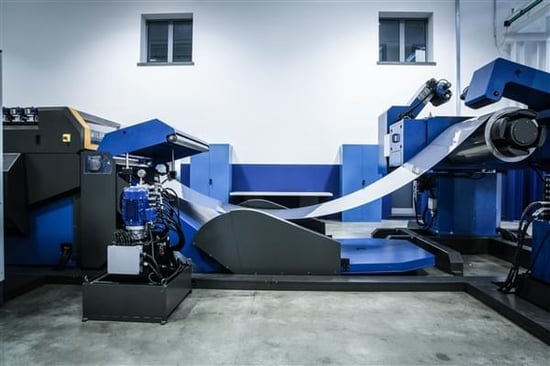
Forming machines are industrial machines that reshape metal or plastic through permanent deformation, using tools, rollers or dies. They neither add nor remove material: the workpiece changes shape while its mass stays the same.
This is what sets forming apart from stamping, a press-based process that can combine forming with cutting operations such as blanking and piercing.
In plastics processing, a vacuum forming machine heats a thermoplastic sheet and draws it onto a mould by suction. In metalworking, forming machines shape blanks, bars and profiles made of steel, aluminium, copper or stainless steel: this page focuses on those that work sheet metal.
Metal forming machines are usually grouped by the way they apply force and by the geometry they produce. The families below cover most applications, from small workshops to industrial production.
|
Type of machine |
How it works |
Typical result |
|
Press brake |
Punch presses the sheet into a die |
Straight bends, channels |
|
Panel bender |
Sheet clamped, bending tools move around it |
Panels, boxes, radius bends |
|
Folding machine |
A folding beam swings to bend the clamped sheet |
Long folds, flashings |
|
Roll forming machine |
Coil strip shaped through roller stations |
Roof panels, studs, door frames |
|
Beading machine (bead roller) |
Shaped rollers press beads and edges |
Stiffening beads, hems |
|
Lockforming machine |
Rollers form interlocking edges |
HVAC duct seams |
|
Stamping press |
Punch and die, in one or more strokes |
Shells, cups, 3D parts |
|
Plate and slip rolls |
Rolls curve the sheet progressively |
Cylinders, cones, curved panels |
|
3-in-1 combination machine |
Shear, slip roll and brake in one bench unit |
Light-gauge workshop parts |
|
Digital sheet forming machine |
CNC tool forms the sheet from a CAD file, no dies |
Prototypes and small batches |
Produtech's forming range covers two of these families: panel bending, with the AC Bend electric panel bender, and beading, with TRIS beading machines.
Choosing among them depends on part geometry, material and thickness, batch size and, above all, on how the forming machine connects to the operations that come before it.
Starting from the coil changes the economics of the whole flow:
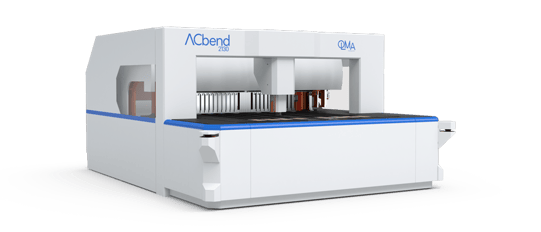
| Technical data | AC Bend |
|---|---|
| Max bending length | 3000 mm |
| Max bending height | 300 mm |
| Bending thickness | 0.5 to 4 mm |
| Drive | Electric |
TRIS machines edge, bead and hem iron, aluminium, copper and stainless steel parts, with three forming units on one machine.
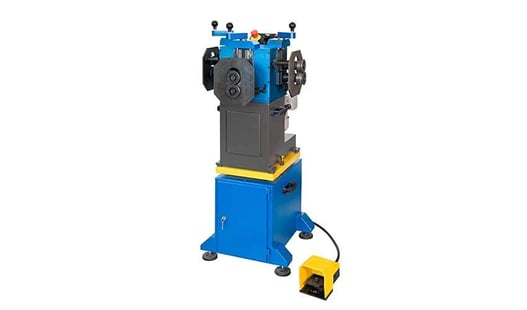
| Technical data | TRIS |
|---|---|
| Forming units | 3 |
| Power supply | Single-phase 220 V, 50 Hz |
| Drive | Gearmotor with frequency converter |
| Roller speed | 10 to 180 rpm, variable |
| Max workable thickness | 1 mm |
| Roller projection | 100 mm |